
Dubai’s content appetite is relentless. Brands here need social media reels for Ramadan, promotional videos for the Dubai Shopping Festival, platform-specific cuts for Instagram, TikTok, and YouTube Shorts — all on tight timelines and tighter budgets. The traditional video editing pipeline, which could take days to move from raw footage to a finished asset, simply cannot keep up.
AI-assisted video editing has changed that equation. What used to take a team of editors several days can now be done in hours, without compromising output quality. Dubai agencies, in-house marketing teams, and content creators are using AI-powered tools to cut production time by 40% to 70%, freeing up more time for creative strategy and storytelling.
This blog covers exactly how that works — from automated rough cuts to multilingual subtitling — and which tools are driving the shift in 2026.
Why Traditional Video Editing Cannot Keep Up With Dubai’s Content Demands

Dubai businesses are producing video content at a scale that was unimaginable five years ago. A single campaign might require a 60-second hero video, five platform-specific cuts, Arabic and English subtitle variants, vertical and horizontal aspect ratios, and thumbnail assets — all turned around within a week.
Traditional post-production workflows were not built for this volume. The manual process of reviewing raw footage, cutting clips, color grading, adding subtitles, and exporting for multiple platforms could consume 20 to 30 editor-hours per project. For agencies handling multiple clients simultaneously, this creates bottlenecks, burnout, and bloated production costs.
The problem is not talent. Dubai has no shortage of skilled video editors. The problem is a production process that requires editors to spend the majority of their time on repetitive, technically intensive tasks, leaving little room for the creative decisions that actually determine whether content performs.
AI-assisted video editing solves this by automating the repetitive layer, so editors and marketers can focus on what machines cannot do: narrative judgment, brand voice, and audience insight.
What AI-Assisted Video Editing Actually Does
AI video editing tools use machine learning to analyze footage, detect patterns, and make decisions that previously required a human editor. They can identify the best clips from hours of raw content, remove unwanted elements from a frame, adapt a video to multiple aspect ratios, transcribe speech, clean up audio, and match color tones — all with minimal manual input.
This does not replace creative direction. It removes the administrative and technically repetitive work that surrounds it.
For Dubai businesses specifically, the most valuable capabilities are the ones that compress turnaround time on social media assets, enable multilingual output, and eliminate the manual re-export process for different platforms.
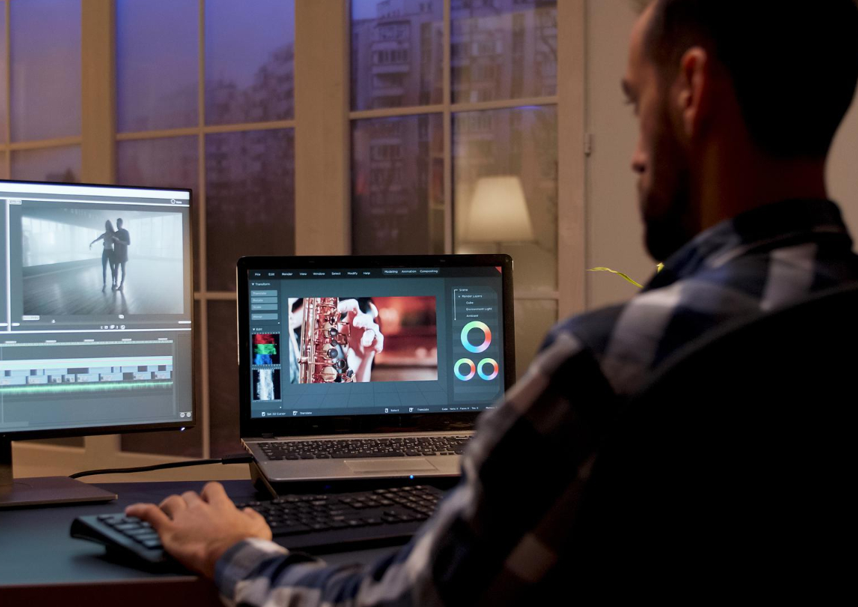
7 Ways AI Is Transforming Video Production Timelines
1. Smart Rough Cuts and Automated Clip Selection
Reviewing hours of raw interview or event footage to identify usable clips used to be one of the most time-consuming tasks in post-production.
Tools like Descript and OpusClip analyze spoken content, identify strong moments based on audio confidence and pacing, and automatically generate a rough cut within minutes. Adobe Premiere Pro’s AI-powered auto-cut features use scene change detection and audio analysis to do the same within the familiar Premiere environment.
For a Dubai brand shooting a full-day product launch event, this means the editing team receives a workable rough cut the same evening, rather than spending two days reviewing footage before a single cut is made.
2. Generative Fill and Object Removal
Removing an unwanted object from footage — a crew member in frame, a competitor’s logo on a shelf, a distracting background element — used to mean frame-by-frame manual patching that could take hours per clip even with a skilled editor.
Adobe Firefly, integrated directly into Premiere Pro, handles generative fill for video, analyzing surrounding pixels to create a seamless replacement. Runway’s Inpainting tool performs the same function, and DaVinci Resolve’s Magic Mask can track and isolate subjects across frames automatically.
For Dubai production teams working on product videos, corporate communications, or event content, these tools eliminate a task that previously required either a specialist VFX editor or a significant increase in production budget.
3. Smart Scene Detection and Content Organization
Organizing unstructured footage — grouping clips by location, subject, event segment, or speaker — is another task that AI handles far faster than a human editor.
Frame.io’s AI tools and Adobe Premiere’s automated bins can tag and organize footage by content type upon import. DaVinci Resolve’s Scene Cut Detection breaks imported footage into individual shots automatically. This alone saves hours on large-scale shoots, where a single day might generate 200+ individual clips.
For Dubai agencies managing content for multiple clients, intelligent organization means editors spend their time making decisions, not navigating folders.
4. AI Color Correction and Grading
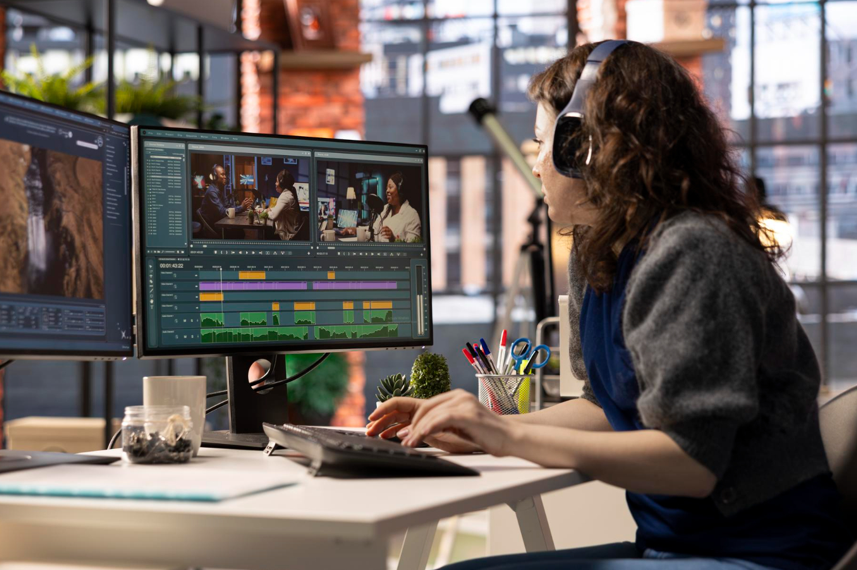
Consistent color grading across a multi-day shoot, or across footage captured on different cameras and lighting conditions, is one of the most technically demanding post-production tasks. Done manually, matching skin tones, correcting exposure, and building a cohesive visual look can take a full working day on a complex project.
DaVinci Resolve’s Color AI automates the initial grading pass, balancing exposure, contrast, and color temperature across all clips before a colorist makes creative adjustments. Adobe Premiere’s Lumetri Color with AI-assisted looks does the same within the Premiere ecosystem. Topaz Video AI handles frame-by-frame enhancement and noise reduction for footage captured in difficult lighting.
Dubai brands frequently shoot in challenging environments — outdoor events in direct sunlight, indoor venues with mixed artificial lighting, nighttime activations. AI color tools significantly reduce the correction time on this type of content.
5. Auto Reframing and Multi-Platform Export
A single video asset now needs to work across multiple platforms and orientations. Instagram Reels and TikTok are 9:16 vertical. YouTube is 16:9 horizontal. LinkedIn accepts both. WhatsApp Status uses 9:16. Manually creating separate exports for each platform adds several hours per week for a busy Dubai content team producing campaign content regularly.
Adobe Premiere Pro’s Auto Reframe uses AI to track the primary subject and automatically crops and repositions the frame for different aspect ratios, generating multiple platform-ready exports in a single action. CapCut AI offers the same functionality with additional template formats optimized for TikTok and Instagram. These tools eliminate the manual resize-and-check process almost entirely.
6. Automated Transcription and Multilingual Subtitling
This is where AI provides particularly high value for Dubai-based brands. Subtitles are not optional in the UAE market — a large proportion of video content is watched without sound, and Dubai’s multilingual audience includes viewers who prefer Arabic, English, Hindi, Tagalog, and other languages.
Manual transcription and subtitle sync for a 5-minute video takes 45 to 90 minutes. For multilingual variants, multiply that.
Descript transcribes and syncs subtitles with speaker-level accuracy, allowing subtitle editing directly from a text interface rather than a timeline. Adobe Premiere’s Speech to Text generates subtitles automatically within the edit. Captions.ai is optimized for short-form social content and supports multilingual output. For Arabic specifically, tools that support right-to-left rendering natively, or export to formats compatible with RTL subtitle editors, are the practical choice.
A Dubai agency producing bilingual social content can reduce subtitle production time from 90 minutes per video to under 10 minutes using these tools.
7. AI Audio Enhancement and Restoration
Audio quality makes or breaks video content. Dialogue recorded in Dubai’s outdoor environments — trade shows, construction sites, rooftop venues — often comes with wind noise, echo, and ambient sound that makes raw audio unusable without significant post-processing.
Adobe Podcast’s Enhance Speech processes a dialogue recording in under a minute, removing background noise and producing studio-quality output from field recordings. Descript’s Studio Sound does the same within the Descript environment. Auphonic handles audio leveling and loudness normalization automatically, ensuring content meets broadcast and platform standards without manual balancing.
For brands producing on-location content in Dubai — where ambient noise from construction, traffic, and crowded venues is a constant variable — AI audio tools alone can save one to three hours per project.

What This Means for Dubai Businesses and Marketing Teams
The cumulative effect of these seven capabilities is a post-production workflow that is fundamentally faster, more consistent, and significantly less expensive to run at scale.
A Dubai marketing team that previously needed a full week to produce one polished video asset can now turn the same asset around in two days. Agencies managing multiple client accounts simultaneously can handle more projects without proportionally increasing team size or budget.
The strategic implication is significant. Brands that can publish high-quality video content faster can respond to cultural moments — UAE National Day campaigns, Ramadan content, the Dubai Shopping Festival — test more creative variations, and iterate based on performance data, all within the window where the opportunity exists.
AI video tools do not replace editorial judgment. They remove the work that surrounds it, so the people making creative decisions can make more of them, more often.
Frequently Asked Questions
What is AI-assisted video editing?
AI-assisted video editing uses machine learning tools to automate repetitive and technically intensive tasks in post-production — including rough cut generation, color correction, subtitle creation, audio cleanup, and multi-platform export. The editor retains full creative control while AI handles the time-consuming administrative work.
Which AI video editing tools are most commonly used in 2026?
The most widely used tools include Descript for transcription and smart cuts, Runway for generative fill and object removal, Adobe Premiere Pro for a fully integrated AI editing workflow, DaVinci Resolve for advanced AI color grading, CapCut AI for social-first multi-platform export, Captions.ai for subtitle generation, and Adobe Podcast for audio enhancement. The right combination depends on content type and production volume.
How much time does AI video editing actually save?
Most production teams report reductions of 40% to 70% in post-production time when AI tools are fully integrated. The biggest gains come from automated rough cuts, subtitle generation, and multi-platform export — tasks that are highly repetitive and scale linearly with content volume.
Is AI video editing suitable for Arabic-language content?
Yes, though tool selection matters. Arabic subtitle output requires right-to-left text rendering, and not all AI transcription tools handle Arabic with the same accuracy as English. For bilingual Dubai content, tools that support multilingual transcription and RTL subtitle formatting — or that export to formats compatible with dedicated Arabic subtitle editors — are the practical choice.
Does AI video editing reduce content quality?
When used correctly, it does not. AI tools automate technically repetitive tasks, not creative ones. The narrative structure, brand voice, visual style, and editorial decisions remain with the human team. Output quality depends on the footage quality and creative direction applied — AI accelerates the process of realizing that vision, not replacing it.
Can small businesses in Dubai use AI video editing tools?
Yes. Most AI video tools are available on subscription models at accessible monthly rates, making them practical for small marketing teams and individual creators. CapCut AI and Captions.ai in particular are designed for social content creators and require no advanced editing background to use effectively.
What types of video content benefit most from AI editing in Dubai?
Social media content (Reels, TikToks, YouTube Shorts), event recap videos, product demos, and bilingual explainer videos benefit most. These are the content types that require high volume, multiple format variants, and fast turnaround — all of which AI editing addresses directly.
Conclusion
AI-assisted video editing is not a novelty. For Dubai businesses producing content at volume, it is now a standard part of a competitive production workflow. The brands benefiting most are those that have integrated specific AI tools into each stage of post-production — not as a replacement for editorial skill, but as a way to make that skill available for more projects, in less time, without increasing cost.
Insights Dubai’s AI video production services are built around these tools and workflows. If your team is producing video content and looking to reduce turnaround time without reducing output quality, get in touch to discuss how AI-assisted production can work for your brand.