
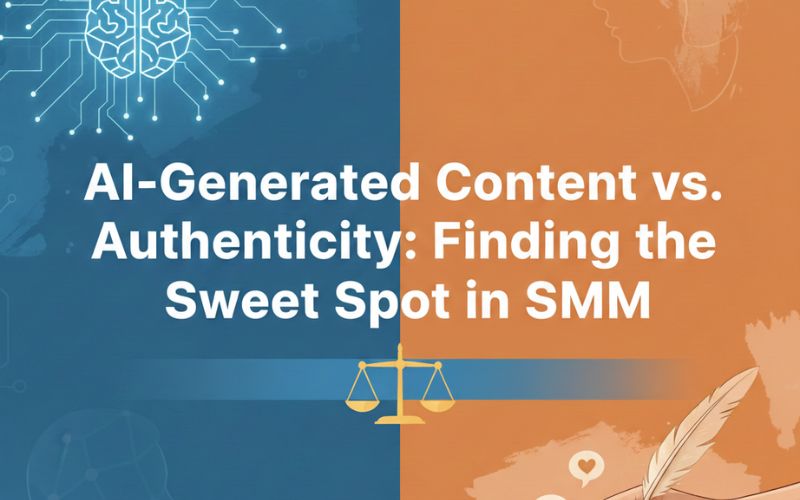
Social media moves fast. Blink, and you’ve already missed the trend, the meme, the “must-post” moment. Marketers are basically expected to be everywhere at once: posting daily, replying instantly, keeping up with whatever TikTok decides is funny this week. But most teams simply don’t have the bandwidth.
Then comes AI-generated content: efficient, scalable, and always on. But there’s a catch: strip everything down to machine-made efficiency, and you risk losing the one thing audiences can sense instantly: realness.
So, do you have to reject AI? No. Instead, use AI and humanness as a combo. Here’s what it’s all about.
The Rise of AI in Social Media Marketing
Planning, creating, and distributing content is all faster, better, and easier with AI. You’ve got predictive analytics, caption generators, automated post scheduling, and whatnot! Less human effort, more reach.
But here’s the downside: when every brand leans on the same tricks, everything starts to look… suspiciously similar. Think of AI-generated stock visuals or captions that repeat safe but bland messaging. Instead of sparking a reaction, posts blur together. The feed becomes white noise, and audiences just keep scrolling.
Why Authenticity Matters More Than Ever
Today’s audiences are hyper-aware. They can instantly spot formulaic content. And they reward brands that feel real. So, is authenticity about flawless polish? Nope. Not even close. It’s about being relatable, about showing the messy, human side that people actually connect with.
Think about the posts that stick with you:
- An employee sharing their honest take on a day at work
- A behind-the-scenes clip that’s a little shaky but full of life
- Real customers talking about what they actually love or hate about a product
Imperfect? Absolutely. Human? Definitely. True to the brand’s voice? Every single time.
90% of people value authenticity. That’s why 93% find UGC helpful. This way, authenticity also drives results. In practice, this means higher click-through rates, stronger loyalty, and better perception of brand trustworthiness.
What This Means for Dubai Brands Specifically
Dubai’s social media environment is one of the most demanding in the world for brands trying to maintain authentic content at volume. The UAE has among the highest social media penetration rates globally, with Instagram, TikTok, and YouTube dominant across demographics. Audiences here are not passive — they scroll high volumes of content daily, develop a strong intuition for what feels produced versus genuine, and disengage quickly when content feels templated.
The multilingual dimension adds further complexity. Effective social media content in Dubai often needs to work across Arabic and English audiences, each with distinct expectations for tone, humour, and cultural reference. AI tools produce English-language content at speed, but Arabic output from most AI writing tools remains noticeably less natural — making the human editing layer even more important for UAE brands targeting Arabic-speaking audiences.
Dubai’s content calendar also creates specific pressure points. Campaigns around Ramadan, UAE National Day, the Dubai Shopping Festival, and major regional events require high-volume, time-sensitive output. This is exactly where AI assistance provides genuine value — generating first drafts, resizing content for multiple platforms, and producing variations for testing. But these are also the moments when audiences are most emotionally engaged and most likely to notice when a brand’s content feels hollow or off-tone.
The brands winning on social in Dubai are not the ones producing the most AI-assisted content. They are the ones using AI efficiently behind the scenes while maintaining the cultural awareness, local specificity, and human voice that an algorithm cannot replicate.
Risks of Overusing AI in Social Media
Imagine scrolling a brand’s feed where every image looks AI-generated. You look at the caption and it feels templated. Plus, no one ever responds personally in the comments. Instead of building connections, the brand risks alienation.
Unchecked reliance on AI creates risks that undermine both engagement and credibility:
- Loss of trust: A feed dominated by robotic captions signals to audiences that no one’s really listening.
- Algorithmic penalties: Platforms like Instagram prioritize posts that spark authentic interaction. Generic AI content gets buried.
- Bias amplification: Because AI is trained on existing data, it can unintentionally reinforce stereotypes or skewed perspectives.
- Misinformation: Automated text or visuals, if not vetted, can spread inaccuracies.
- Privacy concerns: AI tools analyze user data. This raises questions around consent and compliance.
- Staleness: Without human creativity, AI posts quickly become repetitive and uninspired.
Emotional Resonance vs. Perfection
AI can generate flawless designs. But “flawless” feels flat. What resonates more? A polished AI image of a product, or a slightly grainy shot of a customer using it with a smile?
Audiences respond to vulnerability, humor, and emotion, the things AI can’t replicate. A team sharing an inside joke in a TikTok video garners more likes than a generic AI-edited reel. The lesson is simple: emotion beats perfection.
How Social Media Algorithms Favor Authentic Engagement
Algorithms actively reward authenticity. TikTok, Instagram, and LinkedIn elevate posts that drive saves, shares, and meaningful comments.
For example, a founder sharing a personal story about a business challenge is most likely to outperform AI-curated “10 tips” content. Why? Because algorithms detect real interaction. And people comment more when they sense real emotion.
But will AI posts still perform well? Yes. But only if paired with authentic engagement. Without that, algorithms will down-rank them.
Best Practices: Blending AI and Authenticity
Here’s how you can weave AI and human creativity together do it:
Human Oversight = Non-negotiable
AI drafts can be quick. But should you post them raw? No. Review everything for tone, accuracy, and context. Make AI your assistant, not your spokesperson.
For example, you might let AI draft LinkedIn captions. But your social media manager can tweak them with customer pain points they’ve actually heard in sales calls. That edit keeps the content sharp and grounded in reality.
Feature Real People Alongside Automation
Can AI captions carry a post alone? Sometimes. But audiences crave faces and stories. Pair automated text with authentic visuals.
For instance, you can share a photo of their customer success team celebrating a milestone, while the caption, polished by AI, highlights how they solved 1,000+ client queries that quarter.
Tell Short, Relatable Stories
Ever wonder why some posts stick while others scroll by? Stories anchor attention. AI can help structure. But humans bring nuance.
For example, do not post a generic “We hit 10K followers!” graphic. Instead, you could share a short clip of the founder thanking the community and recalling the first 100 followers.
Answer Questions Like a Human, Not a Bot
Audiences often test: “Is someone real behind this account?” Use AI to frame quick replies. But always add personality and brand expertise.
Suppose a user asks about product pricing on Instagram. AI might draft a polite reply. The manager adds, “Happy to walk you through options if you DM, we know choosing the right plan can feel overwhelming.”
Ditch Generic Phrases for Specifics
AI often defaults to clichés: “Unlock your potential” or “Driving innovation.” Readers scroll past. Swap them for concrete, relatable lines.
Instead of “We value our customers,” a wellness brand could post: “When John told us our app helped him meditate daily for 30 days, we knew we were onto something.”
Be Transparent About AI Use
Do audiences really care if AI is involved? Increasingly, yes. Transparency builds trust. Mention where AI supports, and highlight the human touch layered on top.
A marketing agency might post, “We used AI to crunch the numbers, but these insights are from our strategist who’s been testing campaigns for a decade.”
Prioritize Quality Over Quantity
Is it better to post daily with AI fillers or fewer, richer posts? Always the latter. Flooding feeds with sameness leads to fatigue.
So, rather than 14 AI-suggested posts a week, you should go for 5 thoughtful ones, mixing product photos with candid behind-the-scenes reels.
Infuse Brand Voice Into Every Post
How do you make sure AI doesn’t flatten your personality? Create guardrails. Every output should sound unmistakably “you.”
Suppose there is a quirky travel company. It can train AI on their past captions full of puns and playful emojis. Then, it can manually adjust final posts so they keep the brand’s signature humor intact.
Frequently Asked Questions
How can you maintain authenticity while using AI to generate social media content?
Use AI for structure and speed, then apply human judgment to everything that matters: tone, cultural references, emotional resonance, and brand voice. Start with a human-written brief or creative direction, use AI to generate drafts or options, and edit the output until it reads like something your brand would genuinely say. The more specific your prompts — referencing your brand’s actual language, audience, and objectives — the less editing the output requires.
Why does authentic content outperform AI-generated copy in social media and AI search results?
Authentic content reflects real experience, specific context, and consistent brand personality — signals that audiences recognise even when they cannot articulate them. In AI-powered search, tools like Google’s AI Overviews and ChatGPT prioritise content that demonstrates genuine expertise and original perspective. Templated AI output, which tends to repeat widely available information without specific insight, is increasingly filtered out by both algorithms and human readers.
How can you tell if content is AI-generated?
Common patterns include overly uniform sentence structure, frequent use of transitional phrases like “it is worth noting” or “in conclusion,” generic examples that lack real-world specificity, and an absence of a distinctive voice. AI content often reads as technically correct but emotionally neutral. Tools like Originality.ai and GPTZero can flag AI-generated text, but the most reliable test is whether the content includes specific insights, genuine opinions, or details that could only come from a human author with real experience.
What are AI authenticity tools for business content?
They fall into two main categories. Brand voice tools — such as Jasper’s brand voice feature or Writer.com — constrain AI output to a defined brand style, making AI-generated content less generic from the start. Detection and review tools — including Originality.ai and Copyleaks — identify AI-generated passages before content goes live. For most businesses, the most practical approach combines a well-documented brand voice guide with a human review step as a standard part of the publishing workflow.
Which technology helped generative AI create convincingly authentic media?
Large language models (LLMs) are the primary technology behind generative AI’s ability to produce human-like text. Models like GPT-4, Claude, and Gemini are trained on large text datasets, enabling them to mirror tone, structure, and context convincingly. For video and image content, diffusion models — used by tools like Midjourney, Stable Diffusion, and Sora — generate visuals by learning patterns from image and video datasets. Output quality improves as models are fine-tuned on more specific, higher-quality data, which is why enterprise-grade AI tools tend to outperform generic outputs for brand content.
How do Dubai brands balance AI content creation with authentic brand voice?
Three steps make the biggest difference. First, build a documented brand voice guide before using AI at all — defining the specific language, tone, and cultural references that represent your brand in the UAE market. Second, use AI for production-layer tasks: caption variations, subtitle generation, repurposing long-form content into short clips, and platform resizing. Third, assign a human editor familiar with the Dubai market to review all AI-assisted content before publishing, specifically checking for cultural fit, natural language in both Arabic and English, and anything that reads as off-brand or generic.
Conclusion
AI is not the threat to authenticity that early commentary suggested. The brands that struggle are the ones treating AI as a replacement for creative thinking rather than a tool that accelerates it.
The practical reality for social media teams in 2026 is that AI handles volume and consistency well, while human creativity handles context, emotion, and cultural nuance. Neither is sufficient on its own. A content calendar built entirely on AI output becomes indistinguishable from competitors using the same tools with the same prompts. A content calendar built entirely on manual production runs out of capacity at scale.
The balance is not a fixed ratio of AI to human input. It is a clear workflow — AI generates, humans judge, and brand voice decides what goes live.
If your team is still finding where those lines sit, Insights Dubai’s social media and content marketing services are built around exactly this challenge.
Connect with us today to elevate your brand with our creative services.
Read More
- Keyword Research Tips: 10 Effective Ways to Find the Right Keywords
- Google Ads vs Meta Ads: Which One Delivers Better ROI?
- Here’s What You Need To Know About Core Web Vitals
- AI vs Traditional Marketing
- Email Marketing in Dubai: How to Build Campaigns That Actually Convert
- Content Marketing in Dubai: The Complete Guide for Businesses in 2026
- SEO Vs PPC: Which Channel Works Better For Your Business?
- Digital Marketing for Real Estate Agents in 2026